Open-Access Research Testbed for Next-Generation Wireless Networks (ORBIT)
Orbit News
Visitor Map

Welcome to the ORBIT (Open-Access Research Testbed for Next-Generation Wireless Networks) Testbed Portal.
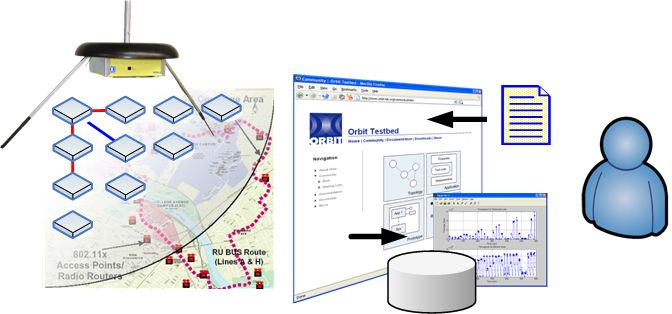
ORBIT is a two-tier wireless network emulator/field trial designed to achieve reproducible experimentation, while also supporting realistic evaluation of protocols and applications. The RADIO GRID TESTBED which is central to the ORBIT facility uses a novel approach based on a 20x20 two-dimensional grid of programmable radio nodes which can be interconnected into specified topologies with reproducible wireless channel models. Once the basic protocol or application concepts have been validated on the radio grid emulator, users can migrate their experiments to the OUTDOOR ORBIT network which provides a configurable mix of both high-speed cellular (WiMAX, LTE) and 802.11 wireless access in a real-world setting. The ORBIT testbed also includes a number of SANDBOX networks used for debugging and controlled experimentation on specific aspects.
ORBIT was first funded in 2003 under the Network Research Testbeds (NRT) program (CNS-0335244) and subsequently under a follow-on grants CNS-0725053, CNS-0958483 and CNS-1513110. The ORBIT radio grid was first released to research users in Oct 2005, and since then has become a widely used community resource for evaluation of emerging wireless network architectures and protocols. As of 2014, there are over 1000 registered ORBIT users who have conducted a total of over ~200,000 experiment-hours on the radio grid testbed to date, with 55,701 experiment-hours served during 2013. The ORBIT testbed is also being used to support wireless aspects of the GENI, and the ORBIT Management Framework (OMF) is being used as one of the core control frameworks in GENI. Examples of specific experiments that have been run on the ORBIT testbed include multi-radio spectrum coordination, cognitive radio networks, dense WiFi networks, cellular/WiFi multi-homing, vehicular and ad hoc network routing, storage-aware/delay tolerant networks, mobile content delivery, location-aware protocols, inter-layer wireless security, future Internet architecture, and mobile cloud computing.
ORBIT is available for remote or on-site access by academic researchers both in the U.S. and internationally (prospective users should first send in an account signup request using the registration form). Users will have access to the following resources:
- Range of radio resources including: WiFi 802.11a/b/g 802.11n 802.11ac, Bluetooth (BLE), ZigBee, Software Defined Radio (SDR) platforms (USRP, WARP, RTL-SDR, USRP N210, USRP X310, USRP B210, Nutaq PicoSDR2x2-E and Nutaq ZeptoSDR )
- Software defined networking (SDN) resources: NEC and Pronto switches, NetFPGA and NetFPGA-10G platforms
- LTE and WiMAX basestations and clients
- Cloud resources (including a number of nodes with Tesla-based GPUs)
(Note that use of OUTDOOR nodes is by arrangement and generally requires physical presence of experimenters on the Rutgers campus).
For the basics of starting an experiment with the testbed refer to the "Getting Started" document and further details information on how to use the ORBIT testbed can be found in the documentation section. Number of tutorials is also available as a starting point for experimentation. Additional information on both the hardware and software in ORBIT can also be found on this site.
Attachments (1)
- orbit-overview.jpg (35.4 KB ) - added by 19 years ago.
Download all attachments as: .zip